
The Ministry of Time by Kaliane Bradley
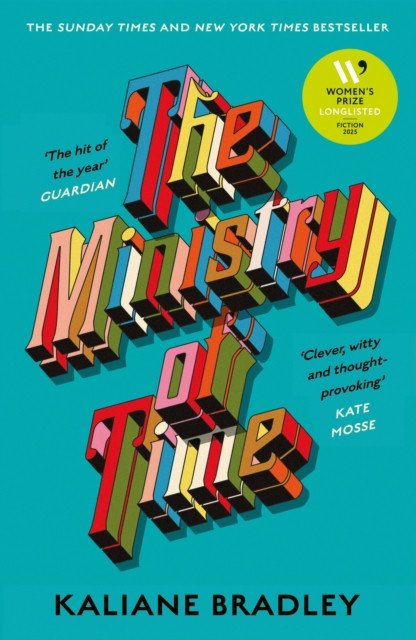
Author: Kaliane Bradley
Genre: Historical Fiction / Science Fiction
Pages: 339
Gray Fox Rating: ★★★☆☆
Goodreads Choice Awards: Winner – Readers’ Favourite Science Fiction.
Obama Recommended Summer Reading List – 2025
⚠️Spoiler alert: This review discusses themes and plot developments but avoids major ending spoilers.
There were things almost everyone could appreciate in The Ministry of Time but those strengths were buried beneath a novel trying to do far too many things at once.
And perhaps that was my biggest frustration with the book. The Ministry of Time had almost everything that should have worked for me: time travel, history, the Franklin expedition, government bureaucracy, colonialism, migration, identity and memory. The premise alone is brilliant. The British government has discovered time travel and begins extracting people from different periods of history shortly before they were supposed to die, bringing them into the present and referring to them as “expats.”
That word stayed with me.
These people are not really expats in any meaningful sense. They did not choose to leave. They have been removed from their worlds and placed somewhere they don’t understand, surrounded by people who know considerably more about them than they know about themselves. They have lost not merely their homes, but everyone who ever knew them. There is something profoundly lonely about that, and I wish the novel had spent more time sitting with it.


Instead, Bradley keeps expanding. We move through colonialism, migration, race, climate change, sexuality, institutional power, historical memory, romance and eventually something resembling a spy thriller. There is an enormous amount here worth exploring, but I often felt that the novel touched these ideas rather than really committing itself to them. This particularly affected the pacing. The first half felt extremely slow to me. We spend a considerable amount of time watching Commander Graham Gore acclimatise to twenty-first-century life while the far more unsettling implications of what the Ministry is actually doing remain somewhere in the background. Then the novel suddenly accelerates, introducing revelations and ethical questions towards the end that I wished had been given much more space earlier.
The tonal shifts didn’t always help. At different points, the novel seems to want to be a workplace satire, historical thought experiment, romance, migration novel and espionage thriller. None of those modes is inherently incompatible with the others, but the movement between them sometimes made the book feel less expansive than crowded.
Gore, however, was easily one of the book’s pleasures. A Victorian Arctic explorer encountering the modern world could very easily have become a running joke, but Bradley allows him to remain a person rather than reducing him to a historical caricature. His encounters with modernity are funny, but there is also something moving about watching someone gradually understand that his entire world has disappeared.
The relationship between Gore and the narrator also worked for me in places, particularly because intimacy becomes another way of exploring the imbalance between them. She knows the historical record of his life and death; he cannot know anything comparable about hers. But I was less convinced by how much narrative space the romance eventually occupied. At times I wanted the novel to resist becoming a love story and remain with the much stranger proposition at its centre: what happens psychologically when a person discovers that history has already finished with them?
The narrator’s British-Cambodian identity adds another interesting layer. She belongs to contemporary Britain and works for the very institution exercising control over these displaced historical people, yet her own family history carries the consequences of migration, violence and empire. Gore has been displaced through time; she carries another kind of historical displacement within herself.

And this is where I ultimately struggled with The Ministry of Time. I didn’t dislike its ideas. I wanted more of them. I wanted the novel to stay longer with displacement, with the ethics of taking someone from history without their consent, with Britain’s instinct to bureaucratise and control something it barely understands, and with the strange imbalance created when you know someone’s history and even their supposed death, while they know almost nothing about yours.
Perhaps the most distinctly British element of the whole premise is not the time machine at all, but the Ministry’s ability to turn an extraordinary moral violation into an administrative procedure.
Perhaps the most interesting question the book left me with is also one it never fully answers: if you save someone from certain death without their consent, have you rescued them—or have you simply found a more comfortable word for taking them?



Too many good ideas, not enough depth.
Udit’s Rating: ★★★☆☆

My rating system is simple. A book born from genuine creativity automatically begins at three stars. Books that challenge me or force me to think earn four. Five stars are reserved for the truly extraordinary. In four years of Gray Fox Book Club, I’ve awarded only two or three books the full five stars.
You’ll enjoy this book if you like:
- You enjoy historical figures being dropped into the modern world.
- You enjoy slow-burn romance alongside speculative fiction.
- You like government bureaucracy, secret departments and spy-thriller elements.
- You don’t mind a novel that juggles several genres and big ideas at once.
- You enjoy books that leave you with ethical questions to argue about afterwards.
Some questions we discussed at Gray Fox Book Club:
This was a particularly good book-club choice because even members who rated it similarly often disagreed about why it worked—or didn’t. Our discussion ended up being far more animated than our average rating suggested. These are some of the questions that sparked the best discussion at Gray Fox.
- How much of our identity comes from the time and culture we live in?
- Did you trust the narrator? Did that change as the book progressed?
- Which historical “expat” would you most want to meet?
- Can someone from the past ever truly adapt to modern values?
- What do you think the novel is saying about colonialism and empire?
- If you could bring one person from history into 2026, who would you choose—and why?
What did you think?
Would you call what the Ministry does rescue—or a more comfortable form of kidnapping?
Leave a comment below.





Thanks for the great review, Udit!
Honestly, I was very excited about this book at first because it explored some genuinely interesting themes. However, I don’t think those themes were well integrated into the story, and I gradually lost all my excitement.
There was too little plot progression and too little character development. This could have been a great story with slightly better writing.